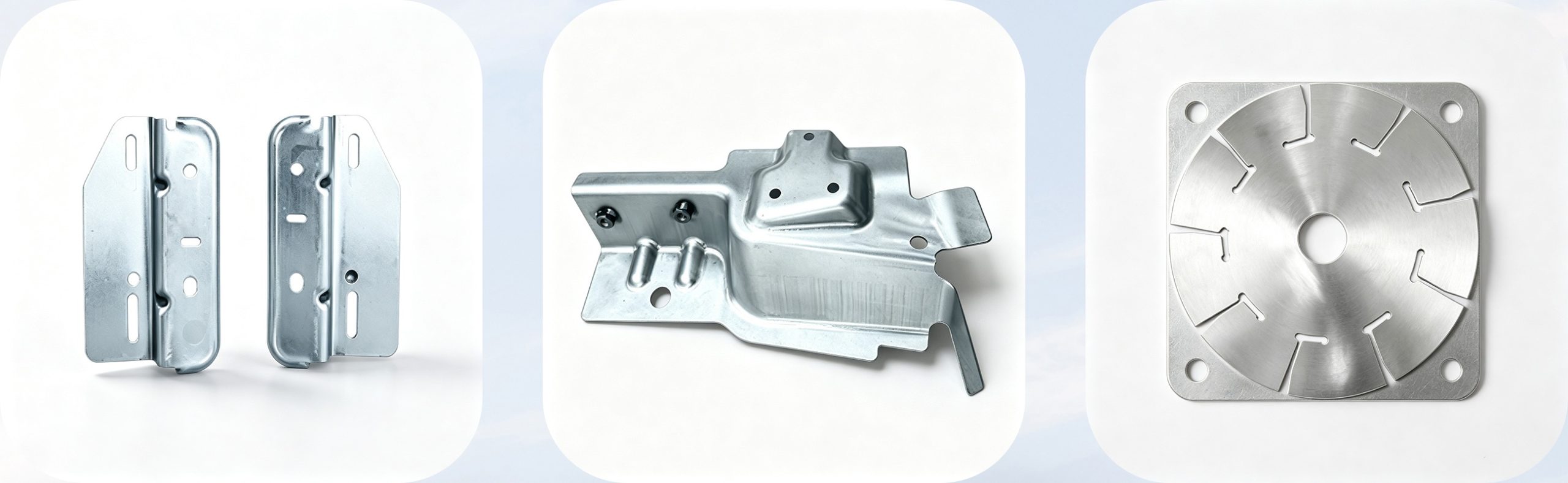
Metal card trays for mobile phones, miniature parts for automobile door locks, copper sheets for air-conditioners, and surgical instruments for hospitals — many metal components with diverse appearances and applications are manufactured via one common production process: precision stamping.
I. Principles of Precision Stamping Forming
The fundamental principle of precision stamping can be illustrated by cookie-shaping in baking. A sheet-metal blank (analogous to dough) is fed into equipment, and a die (analogous to a cookie cutter) exerts downward pressure to form a component. The equipment repeats this action at an extremely high frequency, completing hundreds of stamping strokes per minute.
The distinction lies in precision and consistency. A 1-millimetre deviation is acceptable for cookies, whereas the tolerance of precision-stamped parts is typically controlled at ±0.01 mm — approximately one-seventh the diameter of a human hair. More importantly, this applies to mass production of millions of units: dimensional consistency must be maintained between the first piece and the three-millionth piece.
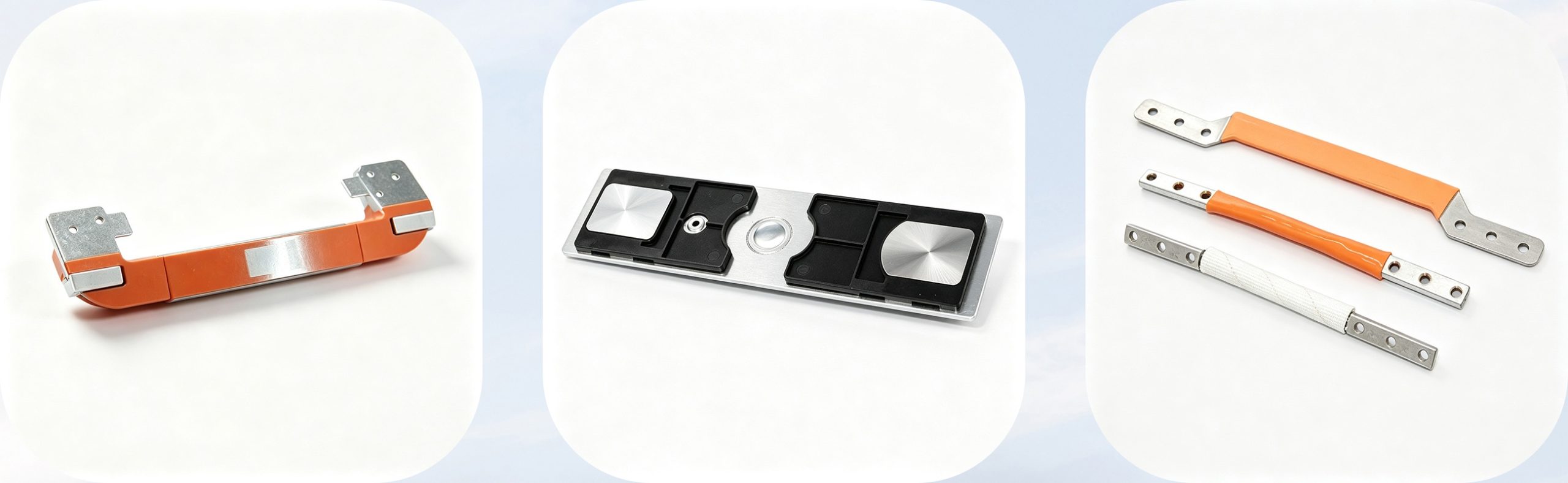
II. Conflicts among Precision, Output and Cost and Resolution Approaches
Conflicts among the three indicators generally stem from differences in corporate resource-allocation priorities. The following three approaches represent methods for allocating resources to appropriate links.
Precision Embedding into Dies Instead of Post-production Sorting
The relationship between dies and components resembles that between a matrix and its replicas: accurate dies yield accurate parts in every forming cycle. Hence enterprises with genuine mass-production capabilities concentrate most of their technical investment on dies:
· Adoption of high-performance die steel for cutting edges to deliver superior wear resistance and preserve dimensional stability after hundreds of thousands of stamping cycles;
· Application of high-precision machine tools for die machining to ensure die errors are significantly lower than the tolerance requirements of finished components.
Unit-Cost Amortisation through High-Speed Operation and Automation
An observable phenomenon in public transport offers an analogy: the fuel consumption of a vehicle barely differs whether it carries one passenger or fifty. The cost structure of stamping production follows similar logic:
· Simultaneous multi-component forming per stamping stroke, which multiplies output within one operational cycle;
· High-speed presses delivering hundreds of stamping strokes per minute;
·Automatic feeding and unloading allowing one operator to oversee multiple production lines.
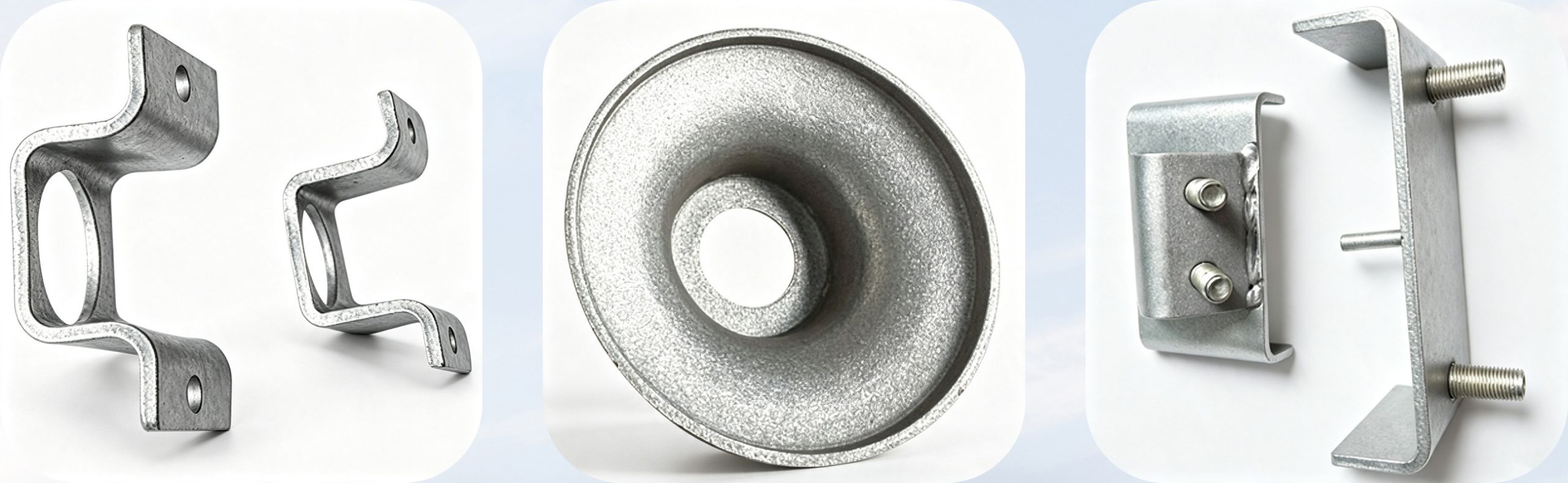
Cost Reduction via Material-Process Optimisation and Process-Data Control
· Improved material utilisation rate: Similar to rational layout when cutting fabric, stamping requires optimised strip layout and scrap-allowance width. This measure alone normally yields a 3%-10% material saving, delivering particularly remarkable benefits for high-priced materials such as copper and aluminium.
· Minimisation of secondary processes: Burr removal and chamfering completed inside dies eliminate subsequent manual polishing procedures.
· Establishment of process-data control: Vision inspection systems and sensors monitor production in real-time.
III. Differentiated Balancing Strategies for Five Major Industries
| Industries | Typical Applications | Industry Characteristics | Balancing Strategies |
| New-Energy Industry | PV junction-box terminals, energy-storage cabinet parts, charging pile internal components | Fast-growing, huge annual demand | Focus on higher material utilisation and production speed |
| Automotive Industry | Motor cores, seat-belt and seat parts, sensor housings | Long product lifecycle, non-stop supply, strict certification | Prioritise stability; focus on die life management |
| Construction Industry | Door-window hardware, curtain-wall and steel-structure connectors, scaffold fasteners | Large-thick parts, moderate precision, high strength and corrosion requirements | Balance durability and cost-efficiency; integrate surface treatments with continuous stamping |
| Furniture and Home furnituring Industry | Hinges, drawer slides, sofa spring fasteners, lamp brackets | High-volume output, strong price sensitivity | Apply in-die deburring and chamfering for appearance-cost balance |
| Industrial Machinery Industry | Motor stators-rotors, gearbox gaskets, assorted connectors | Diverse parts, widely-variable batch sizes | Match processes to batch size: simple dies for small batches; high-speed progressive dies and automation for large batches |
IV. Prioritised Quality Assurance as the Core of Balanced Performance
For precision stamping to realise high precision, high throughput and low cost simultaneously, constant reinforcement on the production floor is not the key. The optimal intervention phase occurs at the product drawing stage, when stamping suppliers are brought in for evaluative consultation. Adjustments to dimensions at this phase incur almost no extra costs.
If you are assessing stamping-process solutions for new projects, please share your drawings and estimated annual consumption with us. We will deliver manufacturability analysis and corresponding process recommendations.