
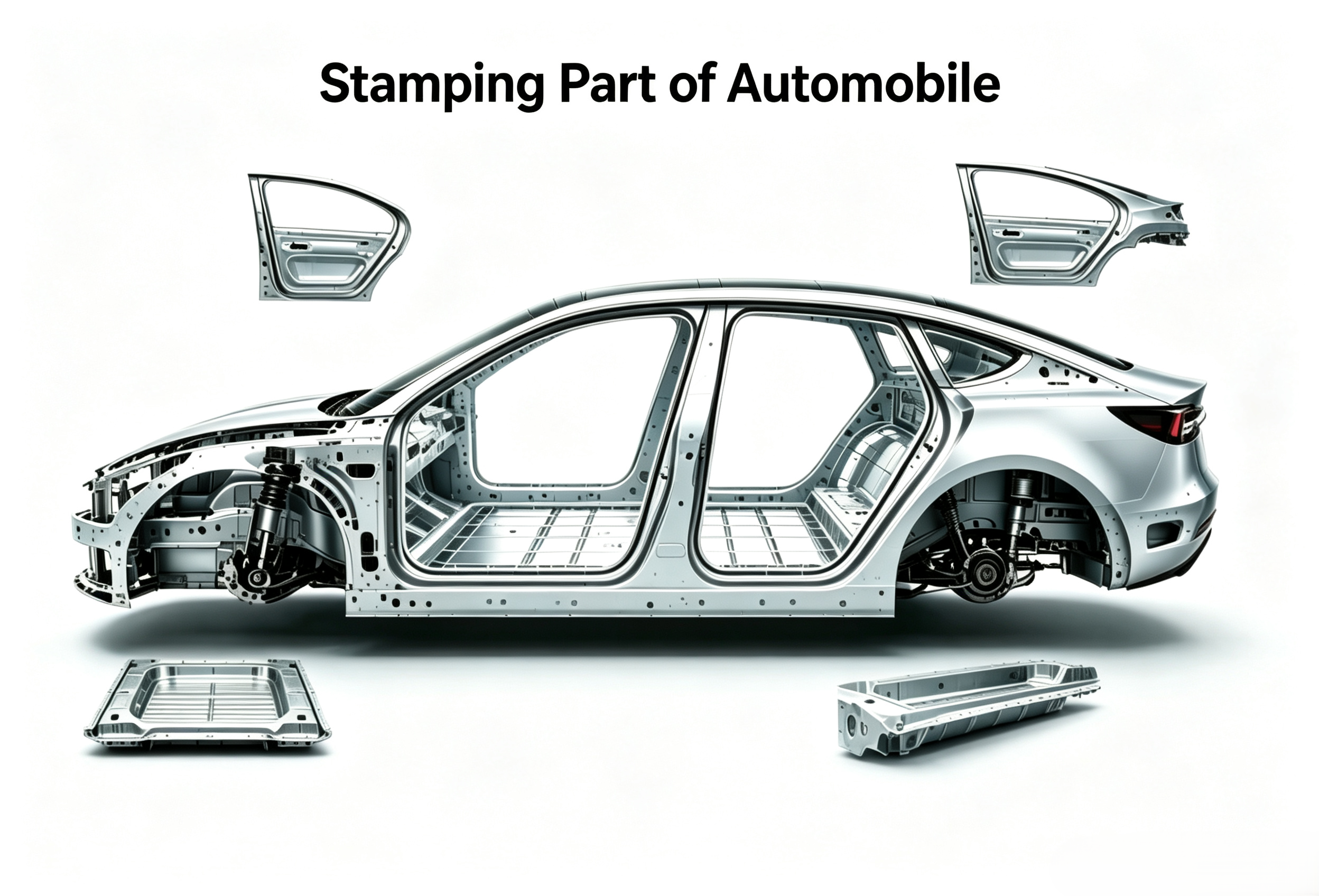
Against the backdrop of far‑reaching global energy‑structure transformation, the automotive industry stands at a pivotal inflection point as it transitions from policy‑led expansion toward market‑driven growth. The sector will keep advancing along this evolutionary path. Fueled by fast‑paced technological iteration, shifting consumer expectations and industrial‑ecosystem reshaping, the new‑energy vehicle industry exhibits well‑defined future development trends. Stamping part of automobile, as a fundamental core component, plays a vital role in this industry shift. Intelligence and lightweighting act as two core driving forces: they are reshaping the value framework of automotive products, while spearheading technological upgrades across the entire industrial supply chain.
Intelligence: Reconstructing the “Soul” of Equipment and the Quality Ecosystem
Under the broader trend toward smart manufacturing in the automotive sector, stamping—as a core process in vehicle body manufacturing—is systematically evolving toward high precision, high efficiency, and high flexibility. Advanced stamping equipment not only facilitates the adoption of new materials such as aluminum alloys and high-strength steel but also enables the reconstruction of manufacturing workflows through digitalization and automation, directly driving improvements in overall vehicle performance and cost efficiency.
Smart Middle-Platform System: Data-Driven Integrated Management
As the nerve center of the “digital factory,” the middle-platform system of the stamping workshop seamlessly integrates production management, equipment monitoring, and process databases, enabling end-to-end visualization across order scheduling, die management, and quality traceability for every stamping part of automobile. The system captures real-time data on key parameters such as press tonnage, speed, and die-closing accuracy, and leverages advanced algorithms to optimize machining parameters—effectively reducing die trial runs and significantly improving Overall Equipment Effectiveness. More importantly, the middle platform interfaces seamlessly with upstream design data and downstream welding data, establishing a solid foundation for “one-die, multi-part” and flexible production strategies.
Visual Alignment System: Sub-Millimeter Precision Assurance
Light‑weight materials including aluminum alloys are highly susceptible to positioning errors in stamping processes. For this reason, visual alignment systems have largely superseded conventional mechanical positioning solutions. Equipped with high‑resolution industrial cameras and sophisticated image‑processing algorithms, such systems enable real‑time, high‑precision detection of sheet‑metal contours and feature holes. Supported by servo‑driven mechanisms for automatic fine‑tuning, alignment accuracy can reach 0.1 mm. This technology effectively mitigates positioning deviations stemming from material spring‑back and surface oil films, significantly lowering stamping‑related defects including cracking and wrinkling. It is especially applicable to high‑volume, high‑quality manufacturing of every stamping part of automobile, including outer body panels such as door assemblies and fenders.
Automatic Loading and Logistics Integration
The handling of every finished stamping part of automobile directly impacts stamping cycle times and surface quality, making the design of automatic loading systems critically important. Through robots or gantry manipulators, stamped parts are transferred to dedicated racks according to predetermined stacking patterns, complemented by visual inspection to prevent scratches and deformation. Simultaneously, seamless integration with Automated Guided Vehicles (AGVs) enables automatic circulation of empty and full racks and cross-workshop automated transport, providing robust logistics support for “lights-out factory” operations.
Automatic Die Preparation System: The Evolution of Quick Die Change
Quick die change must effectively adapt to the demands of multi-model mixed production. The automatic die preparation system compresses die preparation time to the minute level. The system comprehensively integrates functions including automatic die identification (RFID/QR codes), automated storage and retrieval, transfer carts, and fully automatic die change mechanisms (encompassing die clamping and utility interface docking). Pre-configured process recipes enable one-click deployment of complete die sets, with dies automatically installed and aligned on the press. This reduces die change time by over 60% compared to conventional methods, significantly enhancing responsiveness for small-batch and customized production.
Blue-Light Scanning Room: Digital Quality Closed-Loop
The blue-light scanning room integrates blue-light scanners with robotic systems to perform full-dimensional automated inspection of stamping part of automobile. By acquiring high-density point cloud data and performing precise comparisons against CAD models, the system generates real-time deviation color maps and inspection reports. This not only effectively replaces traditional inspection fixtures but also achieves micron-level precision verification for surfaces, hole positions, and other critical features. Most importantly, inspection data is promptly and reliably fed back to the process design team to optimize die compensation and stamping parameters, establishing a true “stamping—inspection—correction” quality closed-loop.
Lightweighting: The Key Path to Enhanced Performance and Driving Range
“Range anxiety” remains the factor that most significantly affects consumer acceptance among the various pain points associated with NEVs. Consequently, the fundamental path to improving range and optimizing performance naturally points toward lightweighting technology. Automakers have developed a clear and pragmatic understanding of lightweighting strategies: reducing vehicle body weight not only lowers energy consumption and extends driving range but also improves handling, safety, and durability. Lightweighting is therefore a critical enabler for achieving the “high performance, low energy consumption” objectives of NEVs.
Material Innovation: From Traditional Steel to Multi-Material Systems
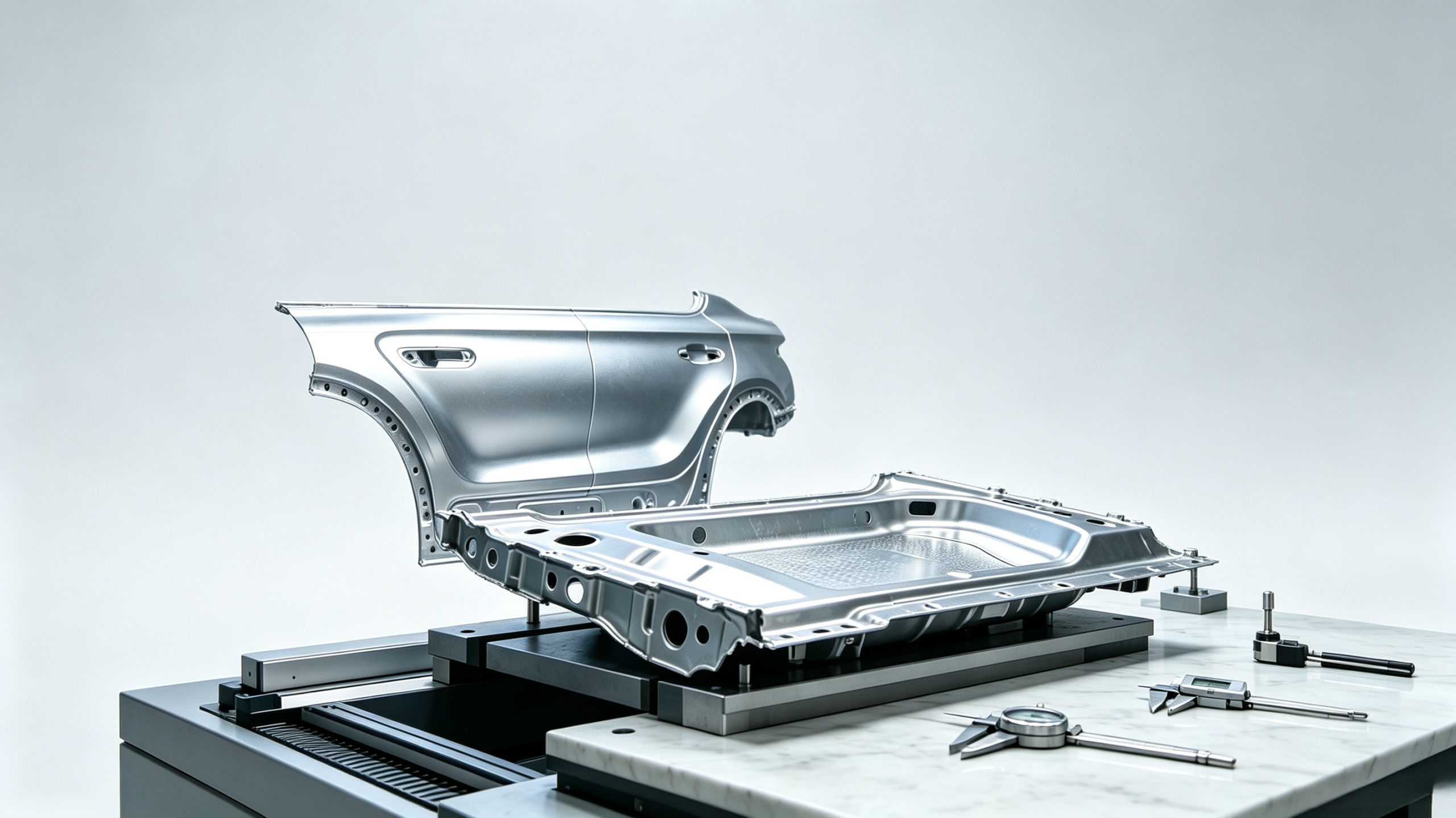
The evolution of body materials is essentially a defining reflection of lightweighting technology progress: while traditional internal combustion engine vehicles primarily rely on steel, NEVs have strategically transitioned toward multi-material systems encompassing aluminum alloys, carbon fiber composites, and high-strength steel. Aluminum body structures, owing to their low density, high strength, and excellent recyclability, have emerged as the mainstream choice for lightweighting every stamping part of automobile.
Specifically, the density of aluminum alloy is approximately one-third that of steel, meaning an all-aluminum body can reduce overall vehicle weight by 30% to 40%, directly contributing to extended driving range for NEVs. Furthermore, aluminum alloys offer superior corrosion resistance compared to steel, making aluminum-bodied vehicles not only lighter but also more durable and safer.
Process Upgrade: From Traditional Stamping to Advanced Manufacturing
Lightweighting cannot be achieved through material innovation alone; it must be accompanied by significant advancements in manufacturing processes. Aluminum stamped parts and cast aluminum components can no longer be adequately produced using conventional stamping and casting techniques to meet the stringent performance requirements of NEVs. As a result, advanced manufacturing technologies—including hot stamping, high-pressure die casting, and laser welding—have emerged in response.
High-pressure die casting technology serves as a compelling example: die casting machines can form chassis components and side frames—which traditionally require the assembly of dozens of individual parts—in a single casting. This dramatically reduces part count and welding points, lowers body weight, and simultaneously increases body rigidity. The process not only reduces manufacturing costs but also inherently improves product consistency and reliability.
For the die and mold industry, the manufacturing of aluminum components introduces new and distinct challenges. It requires overcoming technical bottlenecks related to aluminum material flowability and wear resistance, while systematically optimizing die design and maintenance processes to ensure the smooth execution of large-scale production.
Structural Optimization: From Localized Weight Reduction to System-Integrated Lightweighting
The underlying logic is clear: “achieving system-level weight reduction without compromising performance.” The lightweighting upgrade of stamping part of automobile should therefore follow a “structural optimization and system integration” approach, adopting technologies such as integrated die-cast body structures, integrated electric drive systems, and lightweight battery packs. At the battery system level, deep integration of battery packs with the vehicle chassis rationally eliminates redundant structures, naturally enhancing both energy density and safety. Similarly, at the electric drive system level, technologies such as flat wire motors and silicon carbide (SiC) power devices improve efficiency while actively reducing system weight—truly achieving a “win-win” between performance and lightweighting.
Challenges and Opportunities
The intelligent and lightweight transformation of NEVs presents both exceptional opportunities for industrial upgrading and inevitable new challenges across the entire supply chain. Automakers, component manufacturers, and die-making enterprises must proactively and boldly embrace these changes to secure competitive advantages in the evolving market landscape.